



Cartilage piercings are one of the most common types of body modifications. We do a lot of them at the studio, and they’re a popular choice for adding personality to your look. However, the healing time for cartilage piercings requires more care and patience than standard lobe piercings. In this guide, I’ll walk you through the basics, from initial jewelry choices to proper aftercare techniques.
Cartilage Piercing Healing Time: What to Expect
The healing time for cartilage piercings is typically 2 to 3 months. This is longer than lobe piercings due to limited blood flow in cartilage tissue. During this healing period, don’t touch them. Don’t play with them. Leave them alone and let them heal.
Try to sleep on the opposite side, and use your phone on the other ear as well. Small adjustments like these help during the healing period.
I know asking someone not to sleep on that side for two months is asking a lot. But do your best. You are going to wake up sometimes where you’re sleeping on top of it, but just switch sides. Be conscious of it and do the best you can.
Best Cartilage Piercing Initial Jewelry: Rings vs Barbells
Your initial jewelry for a cartilage piercing is usually going to be one of two things: captive bead rings or barbells.
Captive Bead Rings
Captive bead rings are going to be usually 18 or 16 gauge, which is the most common for people to start with. But you can also do a 14 gauge if you want something on the thicker side. A 3/8 inch diameter is also a common size to start with for cartilage piercing jewelry.
So you have an 18 gauge 3/8 inch captive bead ring, a 16 gauge 3/8 inch, or a 14 gauge 3/8 inch.
Barbells for Cartilage Earrings
If you didn’t want to start with a ring and just want a plain stud, a gem, or a plain ball, then you would do barbells. 18 gauge barbells are becoming popular. But you can also do 16 gauge and 14 gauge.
With those barbells, you have the option of putting gems or whatever you want on the front, depending on what jewelry you pick up or what your local piercer has.
Proper Barbell Length for Swelling
The length of the barbell is important. You never want to start with anything shorter than 5/16 inch. So 5/16 inch is going to be your standard bar size to start with, or bar length. The reason for that is you need room for swelling. Cartilage piercings tend to swell significantly in the back. So give it that room.
When Should You Downsize Cartilage Piercing?
After around 2 months, you can downsize. You can put a lot more snug, tight bar in there if you want to, or even a smaller ring for that matter.
Cartilage Piercing Jewelry Options After Healing
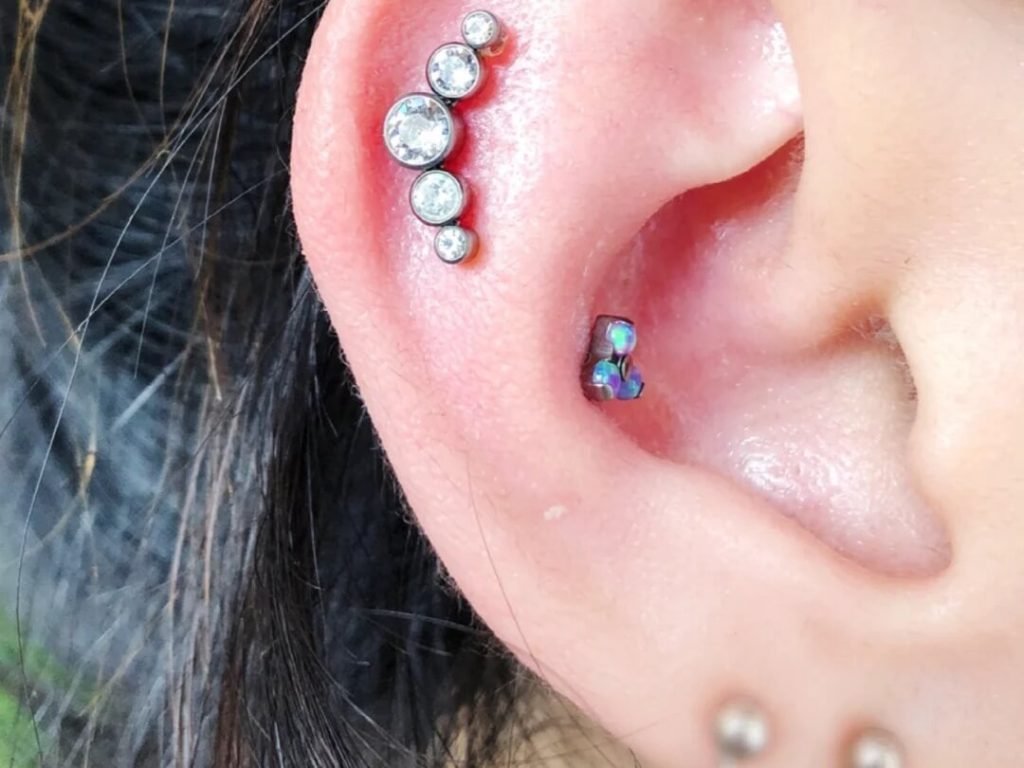
After that 2 to 3 months of healing, you have a world of options for cartilage earrings. There’s all the fancier jewelry. There’s a million different gem types and gem settings and multiple gems.
You have the rings with all the elaborate ornamental stuff on there. You can totally swap that out, but wait until it’s good and healed. Two months is usually about the soonest for that.
The more elaborate stuff is amazing once you’re healed, but it just has so many nooks and crannies for dirt and bacteria to hide in that it makes it hard to heal.
Cartilage Piercing Aftercare: How to Clean with Saltwater Soaks
Proper aftercare is essential for preventing infection in cartilage piercings. The best method for how to clean your piercing at home is the saltwater soak.
Just to go over it again, here’s the saltwater soak method for piercing aftercare:
Go to any grocery store and purchase a gallon of distilled water. It’s inexpensive—usually about a dollar in the drinking water section—and widely available.
Then go to the salt section and get some non-iodized sea salt. Non-iodized sea salt is a pure sea salt. So you should always be able to read that ingredients list and the only ingredient is sea salt. Non-iodized is what you’re looking for.
Take both those items home. Add 4 teaspoons of the salt to the one gallon of water. Shake it up. This creates a solution you can store and use throughout the week.
Once or twice a day, take a coffee cup and fill it up with the salt water solution. Microwave it for a few seconds. You barely want it at body temperature until you have it lukewarm. Submerge your ear in the solution and just let it soak.
On average, about 7 to 15 minutes. Sounds like an eternity, but it will pass quickly. Just sit there, watch TV, do whatever you need to do, but get through that 7 to 15 minutes.
Quick Cartilage Piercing Care Tips
How to care for ear cartilage piercing? To ensure smooth healing and avoid common cartilage piercing problems, follow these key practices:
- Sleep on the opposite side to avoid pressure on the piercing
- Don’t touch, twist, or play with the jewelry
- Use saltwater soaks once or twice daily for 7 to 15 minutes
- Be careful not to bump or snag the piercing on hair or clothing
- Wait at least 2 months before changing to decorative jewelry
- Avoid swimming pools and other bodies of water during healing
These simple habits can significantly reduce healing complications and prevent issues like swelling or irritation.
Problems with Ear Cartilage Piercing: Bumps and Swelling
One thing I didn’t go over yet is a common thing you see with cartilage piercings: irritation bumps, keloids on the back, or hypertrophic scar tissue. Whatever you want to call it.
Learn more: how to get rid of piercing bump
What Causes Cartilage Piercing Bumps
They’re common. You see a lot of people get these big bumps on the back of the piercing. What that’s from is too much movement during the healing.
Too much movement means you’re sleeping on it too much. You’re bumping and knocking it too much. You’re catching and snagging it.
How to Prevent Hypertrophic Scarring
If you constantly bump it, snag it, or sleep on it during the first two months, you might develop hypertrophic scarring. But like I said, nothing major in the world. We just don’t have to do that if we don’t have to.
Treatment Options
How to get rid of cartilage piercing bumps? If that ever happens, there are little tricks to make them go away, which we’ll go over in another post further down the line. But just know there are simple solutions to get rid of it. But you don’t have to go down that road if you don’t have to.
Summary
Pretty simple. That’s cartilage piercing 101. Here’s what to remember:
- Healing takes 2 to 3 months (longer than lobe piercings due to limited blood flow)
- Start with captive bead rings or barbells (18, 16, or 14 gauge)
- Barbell length should be at least 5/16 inch to allow room for swelling
- Use saltwater soaks for aftercare: 4 teaspoons non-iodized sea salt per gallon of distilled water
- Soak 7 to 15 minutes, once or twice daily
- Avoid sleeping on the piercing to prevent hypertrophic scarring and bumps
- Wait 2 months minimum before changing to fancy jewelry
That’s it.